Tuesday, May 25, 2010

Communication

Importance Of Communication System

What is communication?
Communication is the act of transmission of information. Every living
creature in the world experiences the need to impart or receive information
almost continuously with others in the surrounding world.

It also means exchange of ideas, thoughts and feeling using a media call Language.

every communication system has three essential elements. They are transmitter, medium/channel and receiver.


Some Major Milestones in the history of communication

Monday, May 24, 2010

Motion Of Rigid Bodies

What kind of motion can a rigid body have?

Let us try to explore this question by taking some examples of the motion of rigid bodies. Let us begin with a rectangular block sliding down an inclined plane without any sidewise that it does not have translational motion is to fix it along a straight line. The only possible motion of such a rigid body is rotation. The line along which the body is fixed is termed as its axis of rotation. If you look around, you will come across many examples of rotation about an axis, a ceiling fan, a potter’s wheel, a giant wheel in a fair, a merry-go-round and so on


Let us try to understand what rotation is, what characterises rotation. You may notice that in rotation of a rigid body about a fixed axis, every particle of the body moves in acircle, which lies in a plane perpendicular to the axis and has its centre on the axis.


Rotation about a fixed axis
A ceiling fan & A potter’s wheel
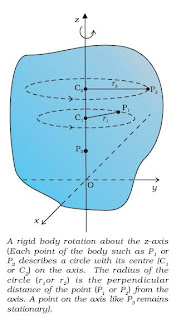


shows the rotational motion of a rigid body about a fixed axis (the z-axis of the frame of reference). Let P1 be a particle of the rigid body, arbitrarily chosen and at a distance r1 from fixed axis. The particle P1 describes a circle of radius r1 with its centre C1 on the fixed axis. The circle lies in a plane perpendicular to the axis. The figure also shows another particle P2 of the rigid body, P2 is at a distance r2 from the fixed axis. The particle P2 moves in a circle of radius r2 and with centre C2 on the axis. This circle, too, lies in a plane perpendicular to the axis. Note that the circles described by P1 and P2 may lie in
different planes; both these planes, however, are perpendicular to the fixed axis. For any particle on the axis like P3, r = 0. Any such
particle remains stationary while the body rotates. This is expected since the axis is fixed.

Thus The motion of a rigid body which is not pivoted or fixed in some way is either a pure translation or a combination of translation and rotation. The motion of a rigid body which is pivoted or fixed in some way is rotation.

Center Of Mass

physics description of center of mass

My blog will help you to learn about center of mass.

We shall first see what the center of mass of a system of particles is and then discuss its significance.

For simplicity we shall start with a two particle system. We shall take the line joining the two particles to be the x- axis.

Let the distances of the two particles be x1 and x2 respectively from some origin O. Let m1 and m2 be respectively the masses of the two particles. The centre of mass of the system is that point C which is at a distance X from O, where X is given by
The terms "center of mass" and "center of gravity" are used synonymously in a uniform gravity field to represent the unique point in an object or system which can be used to describe the system's response to external forces and torques. The concept of the center of mass is that of an average of the masses factored by their distances from a reference point. In one plane, that is like the balancing of a seesaw about a pivot point with respect to the torques produced.

SYSTEMS OF PARTICLES

Introduction On System Of Particles.

I am interested to give introduction on System Of Particles.

A system of particles means a group of particles inter-related. The equations for a system of particles can be readily used to develop those for a rigid body. One new but very important concept introduced with a system of particles is the center of mass.

The following quantities are covered in this section.

* Center of Mass
* Momentum
* Angular Momentum
* Kinetic Energy

For more help on these problems we can always refer sites like http://www.tutorvista.com/and http://www.s-cool.co.uk. I have used these sites for learning these topics and understanding the concept better.


Our next topic is introduction on center of mass.

Friday, June 26, 2009

Problem on Focal length

Topic:-Focal length

The focal length of an optical system is a measure of how strongly it converges (focuses) or diverges (defocuses) light. A system with a shorter focal length has greater optical power than one with a long focal length; that is, it bends the pencil of rays more strongly, bringing them to a focus in a shorter distance.

Question :-

A girl is applying make-up in a concave mirror. Her face is 35cm in front of the mirror. The image is 72cm behind the mirror. Using the mirror equation find the focal length of the mirror. What is the magnification of the image?

ANSWER:

Focal length of the mirror=68.108 cm, Magnification of the image=2.057

The mirror equation expresses the quantitative relationship between the object distance (do), the image distance (di), and the focal length (f). The equation is stated as follows:


1/f=1/ do +1/ di

do=35 cm

di=-72 cm

1/f=1/35-1/72

Focal length = f=68.108 cm

The magnification equation relates the ratio of the image distance and object distance to the ratio of the image height (hi) and object height (ho).

m = - di/ do=-(-72)/35= 2.057

The magnification of the image=2.057.

Friday, June 19, 2009

Force,Types of force with an Example

Topic :- Force

In physics, a force is a push or pull that can cause an object with mass to change in velocity.

Types of Force :-


electromotive force
the force that, by reason of differences in potential, causes a flow of electricity from one place to another, giving rise to an electric current.
moment of force
the effect of a force exerted on a lever and about a fixed point.
reserve force
energy above that required for normal functioning. In the heart it is the power that will take care of the additional circulatory burden imposed by bodily exertion.
shearing force
a force exerted perpendicularly to a horizontal surface.

Here is a problem which shows,how to find force

1. 10 kg lawn mower is pushed along by a force applied at a 20° angle to the horizontal. If the mower accelerates at 3.4 m/s^2. what is the force?

ANSWER: 107.33N

Mass=10kg

Angle=20 °

Acceleration =3.4m/sec^2

F sin (theta) =mg

mg
F= ---------
sin θ

10*9.8
= ---------
sin (20)
98
= -------
sin (20)

F =107.33N (Answer)

I hope it helped you,for more physics help you can reply me.

Friday, June 5, 2009

Question on Frequencies of Sound Harmonics given Fundamental Frequency

Waves and Sounds is one of the basic concept in Physics which deals with wavelength, frequency and velocity of waves and sounds under uniform motion. Initial Frequency generated by any instrument is called as fundamental frequency and sound harmonics.

Topic : Frequencies of successisive Sound Harmonics

In the problem below, an instrument vibrates to produce sound harmonics and it is all about how to find out frequency of those sound harmonics.

Question : If a violin string vibrates at 440 Hz as its fundamental frequency, what are the frequencies of the first four harmonics?

Solution :

A violin is a both ends fixed, and so successive harmonics are simply multiples of the fundamental:
Therefore, f1 = 440Hz (fundamental frequency)
f2 = 2f1 = 2 x 440 = 880 Hz
f3 = 3f1 = 3 x 440 = 1320 Hz
f4 = 4f1 = 4 x 440 = 1760 Hz


For more explanations related to the concept can be found in physics help or science help.